
Integrating early elementary science and explicit oral language instruction

There is a growing understanding of the importance of building content knowledge in the elementary years, both for its own sake and for reading comprehension. Despite this, there is little information on best practices for teaching science in early elementary.
Many high-impact science of learning methods understandably involve reading and writing, something early elementary students cannot do at speed. While a growing body of research explores ways to integrate content instruction with ELA, this work tends to come from an ELA perspective and is therefore limited in scope. The science education research community is unfortunately of minimal help as it is devoted to a student-centered NGSS-approach that deemphasizes content.
My search for guidance on how to explicitly teach early elementary science resulted in the realization that I would have to piece together disparate pieces of research myself. This post focuses on one of the most significant conclusions to emerge from that process - that explicit oral language instruction must be a central component of early elementary science teaching. This discussion focuses on science, as that’s my area of expertise, but can be applied to social studies and general “knowledge-building” as well.
Language is a critical part of early science instruction.
Science instruction is often thought of as niche, or a “nice-to-have,” but not essential. However, especially for early elementary school, nothing could be farther from the truth. At this age, science instruction helps students make sense of not only the extraordinary, but also the ordinary.
For early elementary students, a large part of science instruction is giving students language to articulate what they see and experience in the world around them. There are many times I have said to a class “You already know this! I’m just teaching you how to talk about it.”
For example, even kindergarten students can usually tell the difference between a tree and a cactus, but can they explain why? With instruction, students should be able to tell you, in a complete sentence, that trees are “woody” and that cacti have spines instead of leaves. For those that work with older students, know that it is not easy for many kindergarteners to say “The difference between a tree and a cactus is …” The phrase “instead of” is also not easy for most five-year-olds.
For another example, students already know that things fall down and not up. But why? After instruction, students should be able to articulate that gravity is a force that pulls things to the earth.
Science instruction is also rife with causal and temporal events and language. (Causal: “The paperclip moved because of the magnetic force.” Temporal: “First, set the block on the starting line. Next, squeeze your air blower.”)
And of course, there is vocabulary. Science readings and activities are rich with vocab. Words that are considered “tier 3” at this age are quite commonly found in a wide range of texts and circumstances. Words like ‘survive,’ ‘absorb,’ ‘gas,’ ‘force,’ ‘gravity,’ ‘object,’ ‘pitch’ etc. are frequently found in fiction, conversation, TV shows, and even song lyrics.
Early elementary science is a perfect vehicle for language instruction. It seems likely that integrating these areas of instruction will be more effective than doing either in isolation.
Why is oral language instruction important in early elementary school?
Early elementary students cannot read or write at high speed (or sometimes at all for early kindergarten). The complexity of what these students can read is far below what they can understand.
Students often primarily interact with text at their reading level in K-3 and then once they are (in theory) fluent decoders, the text complexity increases substantially. Text complexity increases in many areas including vocabulary, assumed background knowledge, concepts, and language structures.
A sudden jump in text complexity in 3rd or 4th grade can be overwhelming and may well be a main contributor to the “4th grade slump.” To combat this, students need to encounter and respond to complex texts and content starting in kindergarten. In order for this to occur, students need to hear complex text through read-alouds. But listening to complex text is not enough. Critically, students need ample practice generating academic language.
Explicit oral language instruction is the missing piece in early science education.
It was clear that there was a critical component missing from early science instruction, but I couldn’t quite grasp what it was. Although I have long told students that being able to talk about scientific phenomena is important, I was largely unaware that there was a specific framework for “language instruction.” Then, a little over a year ago, I discovered the Story Champs oral language program - it was a “clouds parting” type of moment. Here, finally, was the answer to this nagging gap.
The connection between early science instruction and Story Champs may not be immediately obvious. Story Champs uses short, “relatable” stories to teach story structure, vocabulary, and language. It is not content-focused. However, they provide a well-researched framework on explicit oral language instruction that is simple, flexible, and customizable.
The “starter” stories in their program are very simple with only 5-6 sentences. Stories are accompanied by basic visuals, as shown in the image below. Teachers read the stories out loud and students identify story elements (problem, setting, etc.). Students then pair up and retell the story. Since it’s delivered orally, the teacher can swap in target vocabulary words as needed and there are multiple versions of the stories that vary in complexity and can be used to target various language structures.
The benefit of the paired retell and other oral language practice may not be clear to those who don’t work with this age group. Please be assured that young learners often struggle with speaking in complete sentences and using academic language and vocabulary. These students need a lot of practice generating language, but this is a challenging task in classrooms of 20+ students. Story Champs provides a structure to do this.
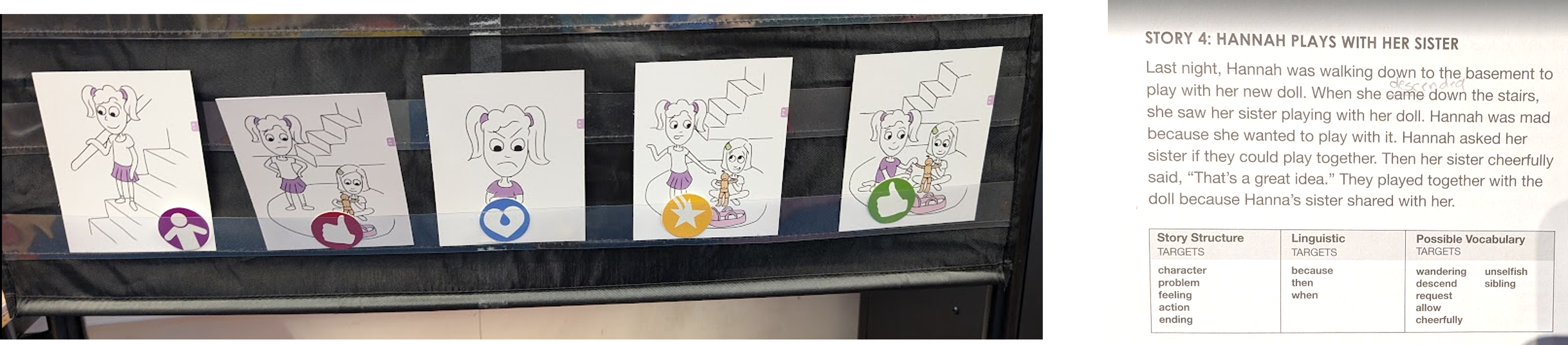
How to use the Story Champs oral language structure with early elementary science.
As mentioned, Story Champs itself does not have a content component. But the Story Champs structure is easy to customize. This is a major reason I was so excited to find this program. There is a lot of research on using “text sets” to teach content, but you can’t design a full science curriculum around read-alouds that someone else wrote. The “text set” method particularly falls apart with physical science topics. There aren’t many high-quality read-alouds around sound waves, for example.
With the Story Champs structure, I can create my own texts - both narrative and informational - that fully align with the design of the curriculum. Additionally, the Story Champs structured oral language procedure can be used with activities. The three major ways the program structure can be integrated with science are the following: 1. Custom narrative stories that reinforce science content. 2. “Pretells” and “retells” of science activities. 3. Informational text.
1. Custom narrative stories that reinforce science content
Narrative stories that mimic the Story Champs structure but incorporate scientific concepts and vocabulary can be developed. The narrative stories fall more squarely under an ELA umbrella, but reinforce science content.
Story example 1: A girl is trying to read but her brother blasts his music so loudly that it rattles the windows. Taught during a sound waves unit for 1st grade.
Story example 2: A boy has a special plant that starts to look unhealthy. He realizes he’s been watering it too much. Plants need water, but they can get too much water too! Taught during a kindergarten unit on plants’ needs.

2. Pretells and retells of science activities
The Story Champs “retell” framework can be used to work on oral language while simultaneously ensuring that students understand the purpose of their science activities. Depending on the age of students and the conceptual difficulty of the activity, multiple parts of the pretell/retell can be introduced at once, or it can be done piece-by-piece.
Pretell
The “pretell” occurs prior to the activity. The teacher explains the 1. Purpose of the activity 2. How the students will do the activity. Students pair-up to tell their partner both items.
Retell
The retell occurs after the activity. The retell has up to four parts, and can be modified based on student age. The components are: 1. What question did we answer? OR What was the purpose of today’s activity? 2. How did we do our activity? 3. What were our findings and/or conclusions? 4. Opinion question such as: What was your favorite part of the activity? What was the most interesting thing that you learned?
The examples below are idealized versions of this activity. In practice, you might give fewer questions, or make other aspects simpler.
Pretell example
Prior to a kindergarten “plant survey,” the teacher would inform the class that they were going to go outside and observe what types of plants were around their school. The class would discuss. Students would then pair up to say: 1. “The purpose of today’s activity is to learn what types of plants are at our school.” 2. “We will do our activity by going outside and observing plants.”
Retell example
After a third grade lesson on the magnetic force, students would do a retell with the following: 1. “The purpose of today’s activity was to learn that magnets can attract or repel other magnets.” 2. “We studied this by placing donut magnets on a pole and seeing if the magnets pushed or pulled each other.” 3. “We learned that magnets have two poles. If two magnets attract, you can flip one magnet and then they will repel.” 4. “My favorite part of today’s activity was . . .”
3. Informational text
Although less developed than their narrative stories, the Story Champs program has a system for informational text that is similar in structure. The bigger challenge with informational text is that, to my knowledge, no one has any guidelines on how to design it for this age group. I hope to address this in a future post.
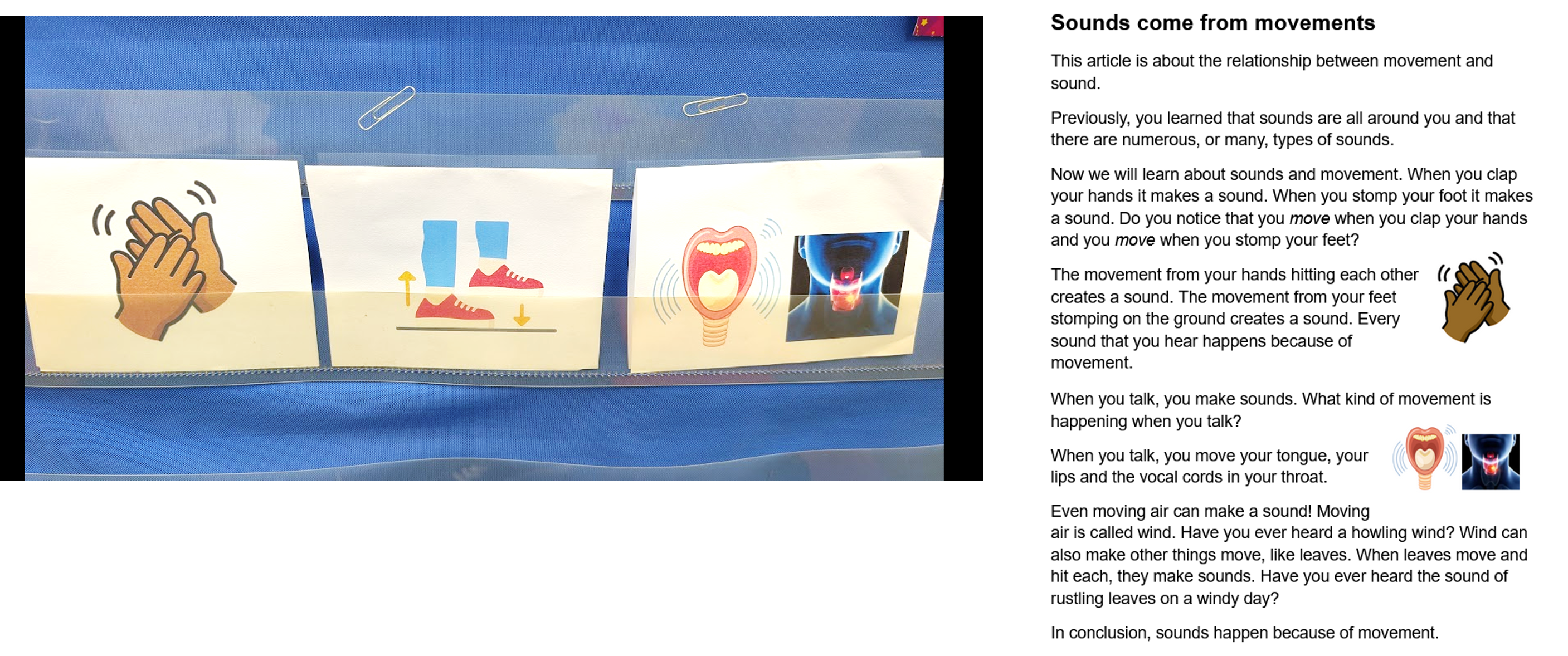
How intertwined can early science instruction and language instruction be?
I am convinced that more science instruction, when done intentionally, will translate into more language practice. There is almost no part of early elementary science that cannot be leveraged to build students’ academic language. Students are SO excited by science activities and their speech reflects this.
Teachers have told me that they hear students talking about our lessons during recess (for example, kindergartners talking about wind and air after an air lesson). In fact, a large challenge in our time-limited enrichment lessons is students can’t stop asking questions and/or wanting to talk about their experiments and related experiences. Leveraging this excitement with explicit language instruction is powerful.
In conclusion
There are many important aspects of early science instruction; this post focuses on one of these aspects - explicit oral language instruction - that is rarely discussed. Oral language practice is likely helpful at all grades, but it is critically important in early elementary when students cannot read and write at speed.
A final note - this post may read like an advertisement for Story Champs. I am happy to advertise their good work but am not affiliated with them! They have a paid program, but many free resources can be found at their site. I hope many early elementary teachers will check it out.
This approach sounds brilliant -- and definitely, the oral language practice your students are getting will lay the groundwork for later reading, writing, and learning in general. Read-alouds are crucial, but so is getting kids to TALK about the read-alouds.
I take your point that it's hard to find good text sets for science topics at the early elementary level, and it sounds like you feel that the science content at Story Champs isn't adequate either -- that's why you created your own. Have you thought about working with Story Champs to improve their science offerings? It sounds like that could benefit other early elementary teachers who may not have the time or the resources to create their own science narratives.
Australian based Speechie here. You had me at “Language is a critical part of early science instruction.”