

In What is looks like when content isn’t cohesive: Part I, I detailed examples of what cohesive content doesn’t look like, using examples from a first grade Benchmark unit, “Observing the Sky.” This post provides additional examples from a second grade unit, “Investigating the Past.”
These units are from the version of Benchmark our school district currently uses. I do not have access to the most recent edition.
Zach Groshell provided a helpful summary of key points of the first post which I repeat and expand here. The Benchmark texts are not cohesive because of the following:
Lack of dependency: Later texts don’t depend on earlier texts.
Lack of recurrence: Key concepts and vocabulary don’t reliably reappear.
Lack of progression: Ideas don’t deepen in a planned way.
Inappropriate content density: Texts either have little substantive content, or they introduce more new concepts than students can reasonably process.
Additionally, some articles do not even maintain focus within the article. This was seen in “The Sun” in the first grade series, and is seen below in “Helen Keller: Words Through Touch.”
Some of the Benchmark themes are more concrete than others. In the first grade “Observing the Sky” unit, the majority of the articles at least focused on the solar system. A strong teacher could therefore supplement in a way that would let students come away with a decent mental model of the solar system.
“Investigating the Past,” however, jumps around in history in a way that makes it difficult to use this collection of texts as a basis for anything content-related.
The unit’s essential question is “How does understanding the past shape the future?” This is a question that would be better to embed in a unit that has a concrete historical focus. Additionally, this question is barely relevant to many of the included articles.
The images below are from the first half of “Investigating the Past,” a second grade Benchmark unit.

The unit starts with “A Look Back at Bell.” This six-sentence article is about Alexander Graham Bell and the invention of the telephone. Students should be able to identify general ways that the invention of the phone changed society, but they are given no historical context or information of what life was like pre-telephone.
Now that we have barely learned about the invention of the telephone, we move on, naturally, to “Buffalo Dusk,” a poem about buffaloes. The near-extinction of the buffalo was a major event in American history, but again, without substantial teacher supplementation, students have no historical information that would make this poem meaningful.
The next article, “The Oregon Trail,” contains four short entries from the fake diary of a girl on the Oregon Trail. Despite supposedly being written in 1849, it reads more or less like modern-day vernacular. No information is given on what the Oregon Trail is. At least we get a call-back to the buffalo (not shown).
The next article is about Helen Keller. Remarkably, the three-paragraph article focuses mostly on tadpoles (see below). I mentioned this to my husband, and my sixth-grade son, who studied this unit, said, “Who’s Helen Keller?” Maybe he remembers the tadpoles.
Next is a story titled “Baseball” and it is about… not much.
The remainder of the packet goes as follows (note not all articles are shown):
“A Gift to America” A three paragraph informational text about the Statue of Liberty. As a stand-alone short text it is focused and decent.
“In the British Museum” A poem about the British Museum. I don’t know anything about teaching poetry at this age so won’t comment there. Content-wise, it’s essentially a list of things in the museum, many of which will be unfamiliar to many second graders.
“Primary Sources” Benchmark packets tend to have one longer, decent informational text. “Primary Sources” fits this description. Here we have words and concepts nicely defined. for example “How do you find out something from the past? One of the best ways is to find primary sources. Primary means firsthand…” All informational texts should meet this standard.
“Grampa’s Treasure Chest” A bland story about a kid looking at photos from his grandfather. Perhaps the photographs are supposed to be examples of primary sources.
“Newton and Gravity” A two paragraph informational text about Isaac Newton and gravity. One of the seven sentences in this article is used, for some reason, to tell us that Newton was small when he was born.
“An Exciting Day in San Francisco” Another fake journal entry supposedly from 1937 with a bland modern voice. It’s about the opening of the Golden Gate Bridge, but I do not feel the excitement. Likely, the students do not either, as no context is given for why this was a big deal.
“A Dinosaur Named Sue. A Journal About My Summer Dig.” Another fake journal entry. This one is at least dated 1990 so the modern vernacular makes sense. This is a longer article with some interesting information. My gut says this would be more interesting to kids if it were presented as a straight informational text.
“A New Discovery” This is about a mummy and tomb-robbing. An interesting topic but kids are given no background information on mummies, Egypt, tombs, or pharaohs.
“Investigating the Past” is all over the place and as a consequence students will learn very little from it. Topics are introduced out of nowhere with no context and then forgotten. The topics that are (randomly and shallowly) addressed in this packet include phones, Alexander Graham Bell, buffalo, The Oregon Trail, Helen Keller, The Statue of Liberty, The British Museum, Isaac Newton, gravity, The Golden Gate Bridge, dinosaurs, mummies, tombs, and Egypt. This is not knowledge-rich. It is, instead, a “list of facts.”
Scattered content hampers ELA learning
Some say that content is important, but that content should be kept to content-blocks. But cohesive, knowledge-building texts only enhance the ELA skills students are tasked with learning. Scattered content makes every ELA exercise more difficult.
For example, the “Build Reflect Write” exercise below asks students to compare the events in “The Oregon Trail” to the events described in “Helen Keller: Words through Touch.” But even as an adult, I am unclear on how one could meaningfully respond to this. The “event” in the Helen Keller article is that she felt tadpoles and then a tadpole went to live in a leafy pool. How do you compare that to someone being on the Oregon Trail? Maybe you could say they both saw animals?
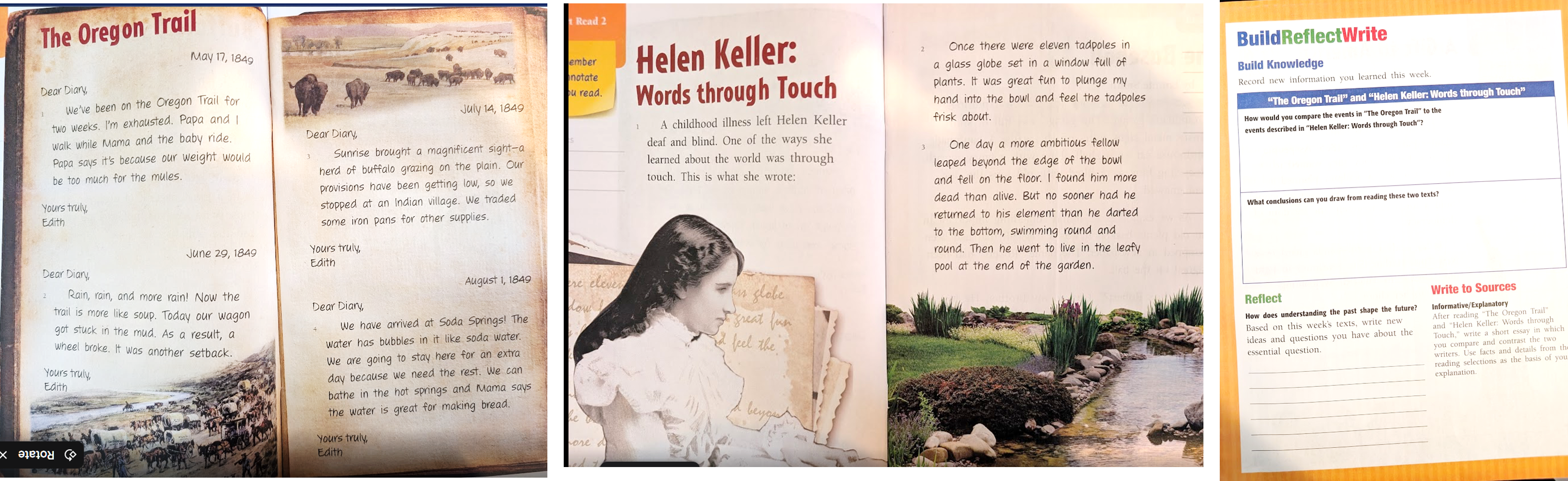
The students are then asked “What conclusions can you draw from reading these two texts?” I eventually realized students are probably supposed to conclude you can learn about the past from diary entries or primary sources. But this conclusion has little to do with the content actually contained in the text.
The only meaningful conclusion to draw from the content of the Helen Keller article, outside of tadpole behavior, is that she used touch to experience the world. This has nothing to do with “The Oregon Trail,” which itself is a series of anecdotes which show that life on the Oregon Trail is hard. These have nothing to do with each other. They also have little to do with the essential question, “how does understanding the past shape the future?”
“Build Reflect Write” is not done with these two unrelated texts. It now wants students to “write a short essay in which you compare and contrast the two writers. Use facts and details from the reading selections as the basis of your explanation.” What?! This is honestly bordering on educational malpractice.
Even without the inappropriate request for comparisons, the Helen Keller article would be difficult to write anything substantial about because it’s mostly about tadpoles.
The Oregon Trail does have some details students could latch onto with an appropriate prompt, however, do students understand this article? Do most eight-year-olds know that some people used to travel by wagons pulled by mules? Do they know what a wagon is? A mule? Do they understand that there weren’t huge stores everywhere and that people were really out on their own? How can students write about what they don’t understand?
A teacher could teach all this information about the Oregon Trail, but then the Benchmark curriculum quickly moves on to a new topic and new era. And we know students forget information quickly if not reinforced. Forcing teachers to constantly pre-teach random bits of content is a waste of time and energy. Our teachers and our students deserve more.
Using informational texts for ELA but refusing to make them cohesive is nonsensical. A knowledge-building curriculum adds to literacy learning and takes nothing away. The question should not be whether to build knowledge, but how best to do it.
This is so depressing. I've recently had several interactions with teachers who tell me that they're using a "knowledge-building curriculum," and when I ask which one, they say "Benchmark Advance." Given what you describe, I would say that while the curriculum has "content," it certainly fails to build knowledge coherently and is little better than a curriculum that is skills-focused and content-light.
The examples of writing prompts that you provide are pretty awful too. Maybe using an explicit, coherent approach to writing instruction embedded in the content of the curriculum could salvage it, but I'm not sure students get enough information about any one topic to enable them to write coherently about it. I suspect a teacher using Benchmark Advance would need to home in on two or three of the topics in the unit and supplement the curriculum with more information about them.
This description of a 2nd grade reading unit is bizarre. And why use fake diary entries from the Oregon Trail when real ones are so interesting?! (Check out these examples, created for middle/high schoolers, but maybe useful to someone? https://docs.google.com/document/d/1vbOHVyk_-bG1qyxlva0FCJ4HLU9WigxZ0PaegnlueNM/edit?usp=sharing)
This is low-hanging fruit: fix the scattered nature of content without coherence. It is a missed opportunity to build knowledge thoughtfully. If it's scattered like this, students miss out on the schema-building that helps them learn more deeply.